
There’s a moment a fresh pedicure can’t fix.
The old polish comes off.
And there it is again. The yellow patch. The thickened edge. The nail you hoped would look different this time.
You look at it for a few seconds. Then reach for the darker shade.
Not because you love that color. Because you know it covers.
Maybe your version is socks at home. Closed-toe shoes in warm weather. Or saying “I’m not really a pedicure person” when the truth is more complicated.
You’ve found ways to keep other people from noticing.
But hiding the nail and dealing with the problem are two different things.
You don’t need another way to make the nail disappear.
You need a plan for what’s happening to it.
That’s the shift behind CoreNail by CoreScripts: from covering a nail you’re worried about to seeking prescription treatment for the fungal infection that may be causing it.
The “cover-up cycle”:
a new color, the same concern.
It rarely starts as a big decision. You cover one nail before a vacation. Then again before a wedding. Then it becomes something you do without thinking.
You get relief from the embarrassment. But underneath, the question stays unanswered.
Cosmetic polish can do its job perfectly while leaving you no closer to knowing what your nail needs.
A better cover-up is still a cover-up.
The next step isn’t a different shade. It’s changing the question from “How do I hide this?” to “How do I treat it?”
Why a nail problem needs more
than a surface-level answer.
If fungus is involved, the challenge isn’t simply the color. It’s an infection in the nail.
The nail plate is a barrier. For topical antifungals, reaching the affected tissue matters. That’s one reason a cream intended for fungal skin infections is not automatically a treatment for fungal nails.1
So the useful questions go beyond “Is it strong?” or “Does it make my nails look better?”
- Is fungus actually the problem? Start with the cause.
- Is this a medication for that problem? Know what you are applying.
- Does the treatment fit my case? Get a clinician’s judgment.
That is a more useful starting point than another bottle chosen because the advertising sounded convincing.
Meet CoreNail.
Prescription treatment.
A purpose beyond the polish.
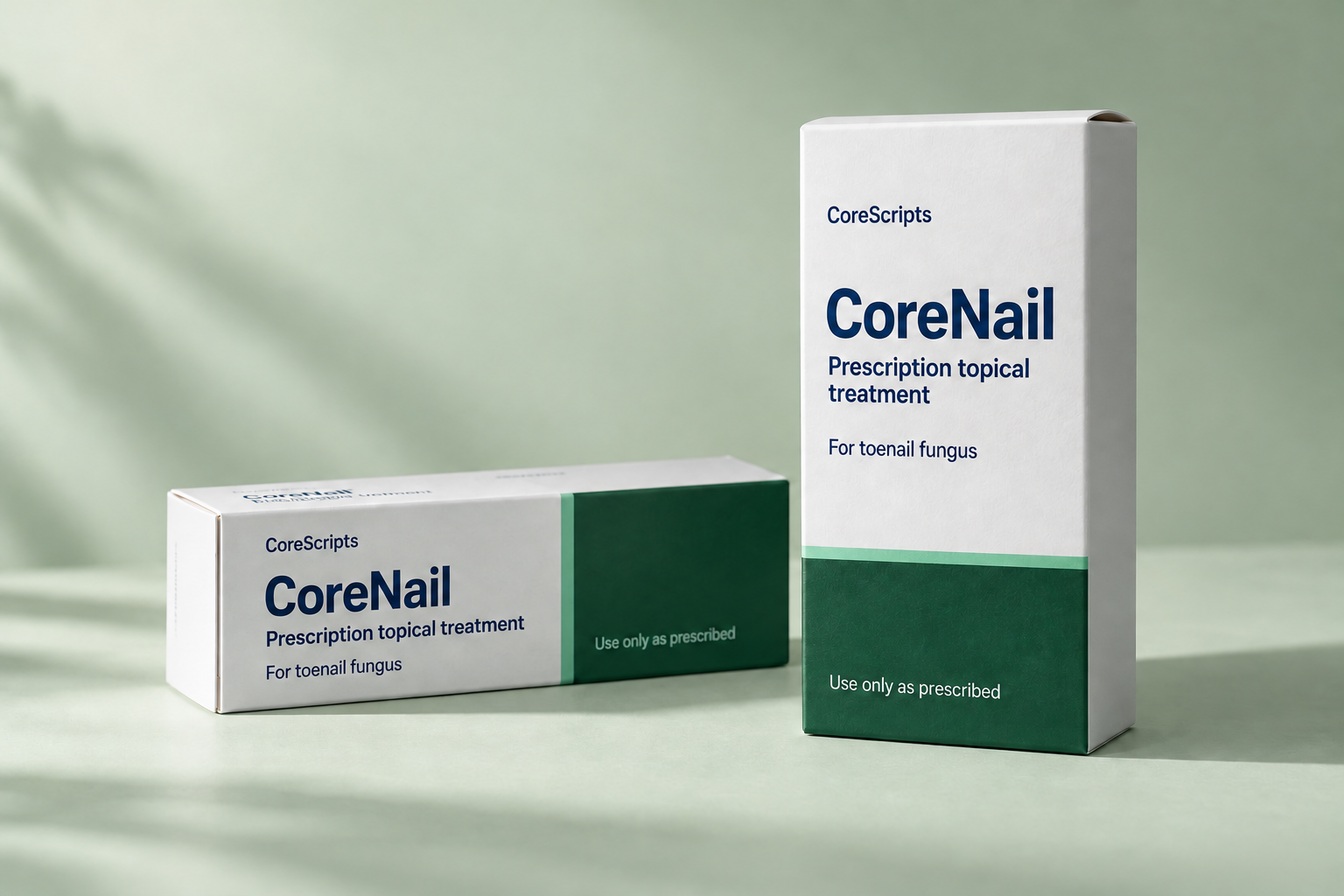
CoreNail is CoreScripts’ compounded prescription topical treatment for toenail fungus.
Its job is to treat a fungal infection. Not tint a yellow nail. Not create a temporary finish. Not give you one more way to avoid looking at it.
You begin with a clinical assessment. If CoreNail is appropriate and prescribed, you receive a topical medication with directions for your treatment.
Prescription treatment
Medication for fungal infection, rather than cosmetic coverage.
Applied to the affected nail
A topical approach to discuss with your prescriber.
A clinical decision
Your diagnosis and health history guide whether it is right for you.
You don’t have to decide which medication to prescribe yourself. Your job is to take the first step and explain what has been happening.
See if CoreNail is right for meSame nail. A different objective.
If you’ve been managing how your nail looks, the difference is straightforward:
| What matters | Cosmetic polish | CoreNail |
|---|---|---|
| The purpose | Change the visible color or finish | Treat toenail fungal infection |
| How it is selected | You choose a shade | A clinician determines suitability |
| What guides use | Your cosmetic preference | Your prescription directions |
| What you are aiming for | A covered nail | A treated infection and healthier nail growth |
This comparison concerns ordinary cosmetic polish. Medicated antifungal nail lacquers are a separate treatment category. Treatment outcomes vary.
You can love a pedicure and still want treatment. You can want a topical option and still need a clinician to determine whether it fits your case.
This isn’t about giving up something you enjoy. It’s about addressing the thing you’ve been working around.
“I’ve tried things before.
Why should this be different?”
That’s a fair question. Especially if your bathroom cabinet already has a collection of half-used bottles.
Before another purchase, look for something more useful than a bigger promise: a clear explanation of the medication, the diagnosis it is meant to treat, and the instructions you will follow.
Diagnosis first.
Treatment chosen for the case.
The American Academy of Dermatology explains that injury and psoriasis can resemble fungal nails. Testing may be needed, and treatment choice depends on the patient and infection.1
Read the AAD’s treatment guidance ↗General medical background. Not an endorsement or clinical study of CoreNail.For CoreNail, that means the assessment matters. A prescription is a decision about your case, not a reward for completing a questionnaire.
If a different treatment, testing or an in-person examination is needed, that is the next step. The aim is appropriate care—not selling the same solution to everyone.
Make room for a treatment routine.
Not another cover-up routine.
You already make time to manage the nail. Checking it. Covering it. Deciding which shoes to wear.
A prescription plan gives that effort a different direction.
Know what you’re treating.
Share your concerns and treatment history in the assessment.
Know exactly what to do.
If prescribed, follow your medication’s preparation, application and follow-up instructions.
Give the plan its full course.
Ask your clinician how to assess progress and when to check in.
Nails grow slowly. The damaged part may remain visible even after an infection clears. A new-looking nail is not an overnight event.1
That’s why the goal is more meaningful than “make this look good by Friday.” It’s taking a treatment seriously enough to see what it can do.
Start making a plan for it.
You don’t need to walk into
a nail salon and explain.
Or ask a friend what she thinks. Or keep comparing anonymous product reviews late at night.
The CoreScripts process starts online, with a clinical assessment.
Tell us about your nails
Share the changes you’ve noticed, your health history and what you’ve tried.
Get a clinical review
A licensed clinician determines the appropriate next step for your case.
Begin prescribed care
If prescribed, receive your treatment at home and use it as directed.
The next decision is small: find out whether CoreNail is an appropriate option for you.
You don’t have to keep guessing just because you’ve been guessing for a long time.
Start treating the problem
you’ve been covering.
CoreNail
For toenail fungus.
Prescribed when appropriate for you.
- Online assessment
- Licensed clinician review
- Home delivery, if prescribed
Prescription required. Clinical review determines treatment suitability.
Before you take the next step.
Is CoreNail a cosmetic polish?
No. CoreNail is a compounded prescription topical intended to treat toenail fungal infection. Cosmetic coverage is not its purpose.
Can I wear nail polish during treatment?
Ask your prescriber about your specific medication. Do not assume you can apply treatment over cosmetic polish.1
What if my nail problem isn’t fungus?
Your clinician may recommend testing, an examination or a different treatment. Nail appearance alone does not always establish the cause.
Will I automatically receive a prescription?
No. A licensed clinician reviews your case and determines whether prescribing is appropriate.
Does topical mean there are no side effects?
No. Ask your prescriber about potential reactions, interactions and precautions for the medication prescribed to you.
Is a compounded prescription FDA-approved?
Compounded drugs are not FDA-approved. The FDA does not verify their safety, effectiveness or quality before marketing.2
Next time you choose a color,
let it just be a color.
Not the only shade that hides the yellow. Not a reason to put off the question for another month.
There is a difference between getting through another pedicure and taking a step toward treating the nail underneath.
Start with that step.
Sources & treatment information
- American Academy of Dermatology — Nail fungus: diagnosis and treatment.
- FDA — Understanding the risks of compounded drugs.
Accessed October 15, 2026. These sources provide general background, not evidence of CoreNail-specific results. Prescription treatment is not suitable for everyone; outcomes vary. Compounded drugs are not FDA-approved.